Our speciality: body hair transplant
Beard to head hair transplant
When the traditional scalp donor area is depleted or insufficient, beard hair offers a powerful alternative. At Zeeva Clinic, beard-to-head transplant is our speciality. Dr. Anchal Shah has refined this technique to deliver natural, dense results for patients who thought they had no options left.
What is beard to head hair transplant?
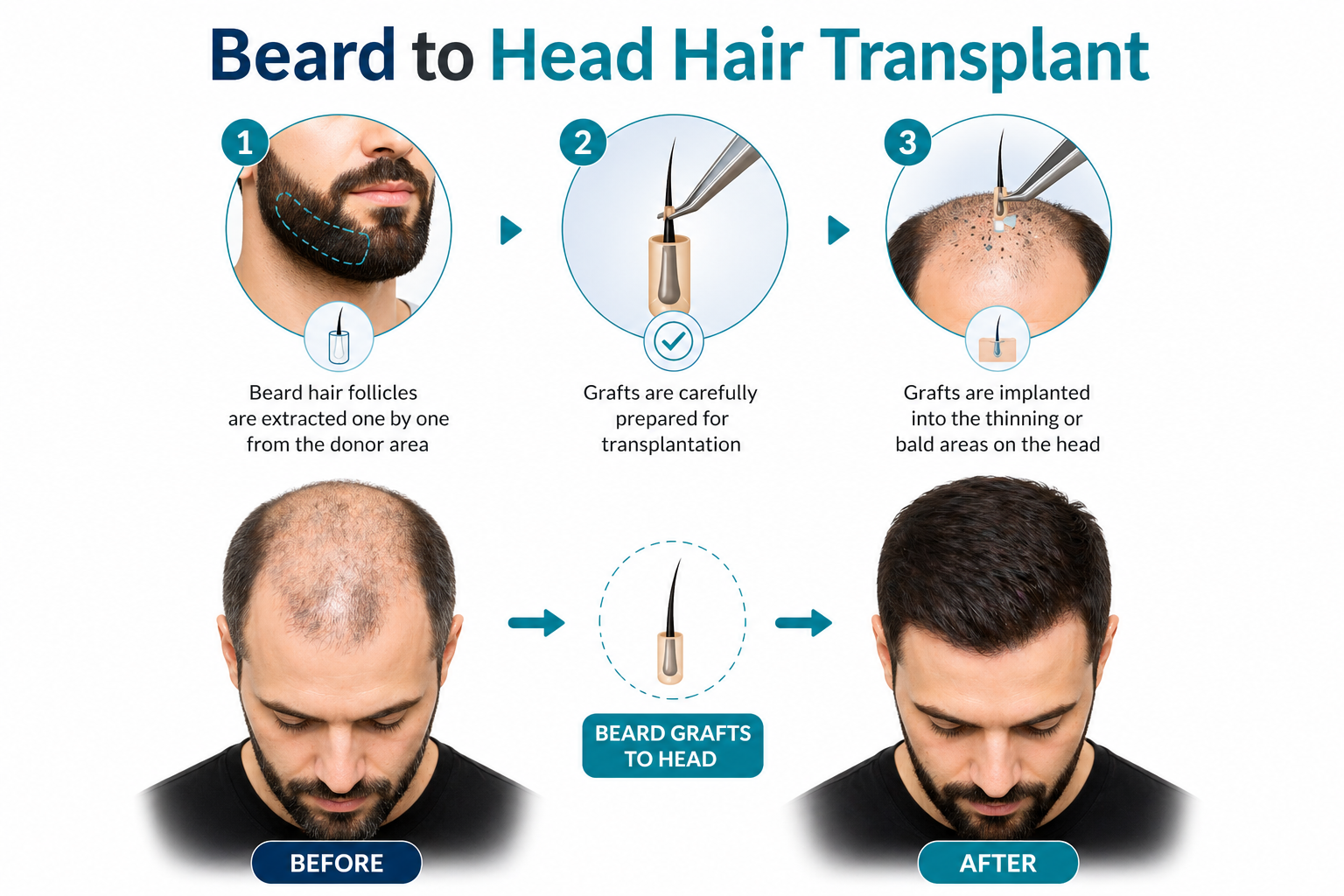
Beard to head hair transplant (also known as body hair transplant or BHT) is an advanced technique where hair follicles are harvested from the beard and chin area and transplanted onto the scalp. This is ideal for patients with limited scalp donor supply, often due to previous transplants, high Norwood grades, or naturally thin donor areas.
Beard hair is the best alternative to scalp hair for transplantation. It is thick, robust, and grows in a similar cycle to scalp hair. When transplanted to the scalp, beard grafts blend naturally with existing hair and provide excellent coverage and density.
Dr. Anchal Shah has extensive experience in beard-to-head transplantation, a technically demanding procedure that requires precise extraction from the curved contours of the face and jaw. Her expertise in this niche technique is what makes Zeeva Clinic a destination for patients from around the world seeking this specialised procedure.
How we perform Beard to head hair transplant at Zeeva
Every step is personally performed by Dr. Anchal Shah, with no technicians and no shortcuts.
Comprehensive review
The Zeeva Clinic team reviews your scalp donor area, beard density, hair characteristics, and overall goals. This helps determine how many beard grafts can be safely harvested without affecting your beard appearance.
Hybrid donor planning
A strategic plan is created combining scalp and beard donor areas for optimal results. The ratio of scalp-to-beard grafts is customised for each patient.
Local anesthesia
Both the beard donor area and scalp recipient area are numbed. The procedure is comfortable and painless throughout.
Beard graft extraction
Using ultra-fine FUE micro-punches, individual follicles are extracted from the beard and jawline. Dr. Anchal Shah personally performs every extraction, following the natural curve of each follicle to ensure maximum graft survival.
Scalp implantation
Beard grafts are strategically placed on the scalp, typically used for crown coverage and adding density. The angle, depth, and direction are calibrated to blend with existing scalp hair.
Key differentiator: Every graft extracted and implanted by Dr. Anchal Shah personally. No technicians handle the critical surgical steps.
Am I a candidate for beard to head transplant?
Ideal candidates
- ✓Patients with depleted scalp donor area from previous transplants
- ✓High Norwood grade (NW5-NW7) requiring additional grafts beyond scalp capacity
- ✓Patients with naturally thin or sparse scalp donor hair
- ✓Those seeking maximum coverage by combining scalp and beard donor sources
- ✓Repair cases where previous procedures exhausted the scalp donor
May not be ideal for
- ✗Patients with sparse or thin beard hair
- ✗Those who want a completely beard-hair-free face after extraction
- ✗Active skin conditions in the beard area
- ✗Patients with adequate scalp donor supply (scalp-only FUE is preferred first)
Norwood scale note: Beard to head transplant is particularly valuable for Norwood 5-7 patients who need 5,000+ grafts to achieve satisfactory coverage. Combining scalp and beard donors can yield up to 8,000-10,000+ total grafts across multiple sessions.
Before and after results
Real patient results from Zeeva Clinic. All procedures performed by Dr. Anchal Shah.

 BeforeAfter
3,000 grafts
United States

 BeforeAfter
2,500 grafts
United Kingdom
BeforeAfter4,000 grafts
UAE
BeforeAfter2,000 grafts
Canada
BeforeAfter3,500 grafts
Australia
BeforeAfter2,800 grafts
India
FUE vs direct hair transplant technique comparison
Understand the differences to make an informed decision with Dr. Anchal Shah.
| Feature | FUE | Direct hair transplant |
|---|---|---|
| Extraction method | Individual follicles via micro-punch | Individual follicles via micro-punch |
| Implantation | Pre-made channels, then graft placement | CHOI implanter placement without pre-made channels |
| Scarring | Tiny dot scars (nearly invisible) | Tiny dot scars (nearly invisible) |
| Recovery time | 7-10 days | 7-10 days |
| Graft survival rate | 95-98% | 95-98% |
| Max grafts per session | 4,000-5,000 | 3,000-4,000 |
| Shaving required | Yes (donor area) | Partial / No-shave option |
| Best for | Large areas, versatile | Hairline refinement, density boost |
| Cost (INR) | From ₹75,000 | From ₹90,000 |
Recovery timeline
Procedure day
Mild redness on scalp and beard area. Small scabs form at extraction and implant sites. Rest with head elevated.
Initial healing
Scabs naturally fall off from both areas. Beard area heals quickly. Gentle washing allowed. Avoid direct sun.
Donor Recovery
Beard extraction sites fully healed and virtually invisible. Scalp implant sites healed. Can resume normal grooming.
Shedding phase
Transplanted beard hairs shed, this is normal and expected. The follicles remain alive beneath the surface.
New Growth
New hair emerges from the transplanted beard follicles. Initially fine, it thickens over time. Beard-origin hair tends to grow slightly thicker than scalp hair.
Full results
Beard-transplanted hair fully matured. The hair is permanent and blends with scalp hair. May require slightly more frequent trimming due to beard hair growth characteristics.
Pricing
Starting at
₹80,000
Beard to head transplant cost depends on the number of grafts extracted from the beard (typically 1,500-4,000). Often combined with scalp FUE in the same session for comprehensive coverage. International patient packages available.
Frequently asked questions
This procedure suits people who need more hair than their scalp can safely give. That often means men with advanced baldness, men whose scalp donor area is thin, and men who have already had a transplant and used much of their donor hair.
A good candidate also needs a healthy, dense beard. The beard is the donor here, so it must have enough hair to spare. Patients with a sparse or very thin beard are usually better served by other options. A skin problem in the beard area needs to be treated first.
Expectations matter too. Beard hair is thicker than scalp hair. It works best for adding density in the crown and middle of the scalp, not for the front hairline. Someone who wants a completely clean face with no beard hair at all after surgery may not be happy with the plan.
Dr. Anchal Shah checks both your scalp and your beard before advising you. Scalp only FUE is normally preferred first when your scalp donor supply is enough. You can start with clear photos sent online, and the team will tell you honestly whether beard hair is needed in your case. Ask any question you have at the first visit, since a clear plan removes most worries before the day arrives.
For most patients, no. The surgeon does not take hair from one small patch. Grafts are spread across the beard and jawline, so that healthy hair is left behind between every point of extraction. This keeps the beard looking even.
The tools used are very small. Each punch is under a millimetre wide, and it leaves a tiny dot that heals within days. These dots sit between the remaining hairs and are hidden by them. Most patients and their friends cannot tell any hair was taken.
The surgeon also decides how much is safe to take. Over-harvesting is the main way a beard can start to look thin or patchy. A careful plan removes only the amount your beard can spare. That is why the team checks your beard density before agreeing on a number.
If you like to keep your beard very short or trimmed close to the skin, tell the team at the start. This matters because a short beard shows gaps more easily. Dr. Anchal Shah can plan the extraction pattern around the style you wear. Many men keep their usual beard look after the procedure. If you are unsure, ask to see photos of past patients a year after surgery, so you can judge the beard donor area yourself.
Beard hair keeps some of its own character after it moves to the scalp. It stays thicker and often a little coarser than your natural scalp hair. This is why it works so well for adding body and density.
Beard hair also grows in a different way. It tends to be slower and stays shorter than scalp hair in its original place. After a transplant, many patients find it grows longer on the scalp than it did on the face. It may need trimming more often than the rest of your hair.
The hair also keeps some of its wave or curl. Beard hair is often curlier than scalp hair, so the transplanted area may look slightly different in texture from the hair around it. A skilled surgeon places the grafts carefully, so that the mix looks natural, especially in the crown where the hair swirls.
Colour can also differ. Some men have beards that are lighter or darker than their scalp hair, or have grey in the beard first. Dr. Anchal Shah will look at this at your assessment. It helps to decide which grafts to use and where to place them, so the result looks even. Ask the surgeon to show you examples at twelve months, so you can see how the mix looks once it has fully grown.
If your beard is thin or patchy, there may not be enough hair to take safely. The beard needs to have good density for this procedure to work. Taking grafts from a sparse beard can leave visible gaps on your face.
Your surgeon will check how many hairs sit in each square centimetre of the beard. This is called donor density. They will also look at the thickness of each hair and the number of hairs in each follicular unit. Together these show how many grafts can be taken without changing how the beard looks.
If your beard is not suitable, other routes may still help. A scalp only FUE may give enough grafts. Body hair from other areas may be an option in some cases. Scalp micropigmentation can also add the look of density to thin areas without any donor hair.
It is better to know this before travelling or booking. Zeeva Clinic offers a video or photo assessment first. You can send clear pictures of your scalp and beard from different angles. The team will give an honest answer on whether beard grafts are likely to work for you. A frank answer at the start saves you time, travel and money, and helps you choose the right path.
Most sessions take between six and ten hours. The exact time depends on how many grafts are needed and where they come from. A session that uses both scalp and beard grafts takes longer than one that uses only one source.
The day has several parts. It starts with planning and numbing. Then the grafts are taken from the beard and jawline, and from the scalp if both are being used. After a break, the grafts are placed into the scalp. Each step is done slowly, because the curve of the face makes beard extraction more delicate.
Dr. Anchal Shah performs the extraction and implantation herself. This keeps the quality steady, though it can mean a longer day than at a clinic that shares the work with technicians. You will have breaks for food, water and rest. You stay awake and comfortable throughout.
Plan to keep the whole day free, and the next day too for a quick check. International patients usually stay in Ahmedabad for a few days. Your team will tell you the likely time once your graft number is agreed. Wear loose clothing that opens at the front and bring something to watch or listen to. Keeping the schedule relaxed helps both you and the surgical team, and it protects the quality of every graft.
The beard area heals quickly. In the first few days you will see tiny red dots and small scabs where each graft was taken. These are normal and usually fade within a week. By the end of the second or third week, most patients find the dots are almost impossible to see.
Gentle care helps. The team will explain how to clean the area and what to avoid. In general, do not scratch or pick at the scabs, and keep your face away from heavy sweat and dust for the first few days. A clean, soft touch is all that is needed.
You may notice a little redness or swelling around the jaw for a day or two. This settles on its own. Some patients feel mild tightness or numbness, which also passes. Because the face has a rich blood supply, healing here is often faster than on the scalp.
The beard hairs around the extraction points keep growing as normal. You will not see a bald patch, because the hair was taken from across a wide area. Most men are back to their normal routine within a week, though your team will give you exact dates for shaving and trimming.
Most patients can start a gentle trim after the scabs have fallen and the skin looks calm. This is usually after the first week or two. Your surgeon will confirm the date at your follow-up, since healing differs from person to person.
Until then, avoid razors, sharp trimmers and any harsh pressure on the face. Shaving too early can disturb the healing skin and may cause irritation or infection. A clean beard that is left alone for the first days gives the best start.
When you do start again, use a clean trimmer on a long setting first. Go slowly and avoid dragging it over any area that still feels tender. Wash your hands before touching your face, and use clean tools. If you use a razor, wait until the skin has fully settled and feels normal.
Remember that your scalp also needs care. The transplanted area has its own healing plan, and you should not scratch or rub it while grooming your beard. Plan your shaving and haircut routine with the clinic team. If anything looks red, sore or oozing, contact the clinic at once rather than waiting. If you are ever unsure whether it is safe to shave, wait a few more days and ask the clinic for advice.
Yes. Hair taken from the beard and moved to the scalp is expected to keep growing for life. The follicle carries its own growth pattern with it, so it does not turn into pattern baldness hair when it moves.
Beard follicles are not affected in the same way as the hair at the top of the scalp. This is why beard hair is a good source for scalp restoration. Once it settles in its new home, it grows, sheds and regrows in cycles, just as it did on your face.
There is one thing to understand. The grafts are permanent, but the hair around them is not protected. If your natural scalp hair keeps thinning, the gap around the transplant may grow over the years. This is true of any hair transplant, not only beard to head.
Many patients keep up some supportive care, such as medicines, PRP or GFC therapy, to slow down further loss. Your surgeon can explain a plan that suits your age and pattern of loss. Seeing the clinic for a check once a year helps you stay ahead of any change. A short chat about long term care at your first visit helps you plan for the years ahead, not just the first year.
At Zeeva Clinic, a beard to head hair transplant starts from around ₹80,000. The final cost depends on how many grafts are taken from the beard. This is usually between 1,500 and 4,000 grafts. More grafts mean a higher cost.
Many patients combine beard grafts with scalp FUE in the same session, to get better coverage. In that case, the price is based on the total number of grafts and the plan agreed with the surgeon. You will get a clear quote after your assessment, so there are no surprises.
International patients can ask about all-inclusive packages. These bring the surgery, hotel, airport transfers and aftercare together. This makes it easier to plan the budget before you travel. Ask the team exactly what is included, so you can compare it with other quotes.
It is wise to compare more than the price. This is a skilled, delicate procedure, so the surgeon's experience matters a great deal. A lower quote from a clinic with less experience in beard extraction can cost more later if repair is needed. Ask who performs each step, and ask to see results for similar cases. Always ask for the quote in writing, so you know exactly what you are paying for and what is included.
Yes, and this is often the best plan. A hybrid approach uses fine scalp hair where it matters most for a natural look, and thicker beard hair where density is needed. The ratio of scalp to beard grafts is planned for each patient.
Scalp hair is finer, so it suits the front hairline. A hairline made of thick beard hair would look too heavy and may stand out. Beard grafts are then placed further back, in the crown and middle of the scalp. There, the thicker hair adds volume without drawing attention.
Using both sources also gives you a larger total number of grafts. For men at Norwood 5 to 7, this can mean the difference between a thin cover and a proper result. The surgeon can plan to use scalp donor hair first and then add beard grafts, or to save some scalp hair for a later session.
The result must blend well. Dr. Anchal Shah matches the angle, depth and direction of each graft to the hair around it. This takes skill and a good eye. Ask to see before and after photos of hybrid cases, and ask how the hair looked at twelve months or more. A clear plan for both donor areas before surgery helps you avoid using more hair than you really need.
The first week is mainly about gentle healing. On the first day, you will have some redness on both the scalp and the beard area. Small scabs form around each graft, and you may feel mild swelling or tightness. These signs are normal.
Sleep with your head raised on extra pillows for the first few nights. This helps reduce swelling. Avoid pressing or rubbing the transplanted area, and do not scratch, even if it feels itchy. Pain is usually mild and can be managed with the medicines the clinic gives you.
Your first wash is usually done at the clinic or shown to you in detail. After that, you follow a gentle routine for both areas. Avoid direct sun, heavy sweating, swimming and hard exercise for the first couple of weeks. Keep your face clean and use only the products the team advises.
By the end of the week, most of the scabs begin to fall away and the beard area looks much calmer. The new scalp hairs will shed in the first month or two. This is normal, and the follicles remain alive below the skin. New growth starts around month four, and the full result takes up to eighteen months.
Ready to get started?
Book an assessment with the Zeeva Clinic team. Get a personalised treatment plan, honest assessment, and transparent pricing with clear next steps.
- Video assessment with the Zeeva Clinic team
- Personalised treatment plan and cost estimate
- Before/after photos of similar cases shared
- All-inclusive packages for international patients
Book your assessment
Get a personalised hair restoration plan