
CHOI Implanter technology
Direct hair transplant
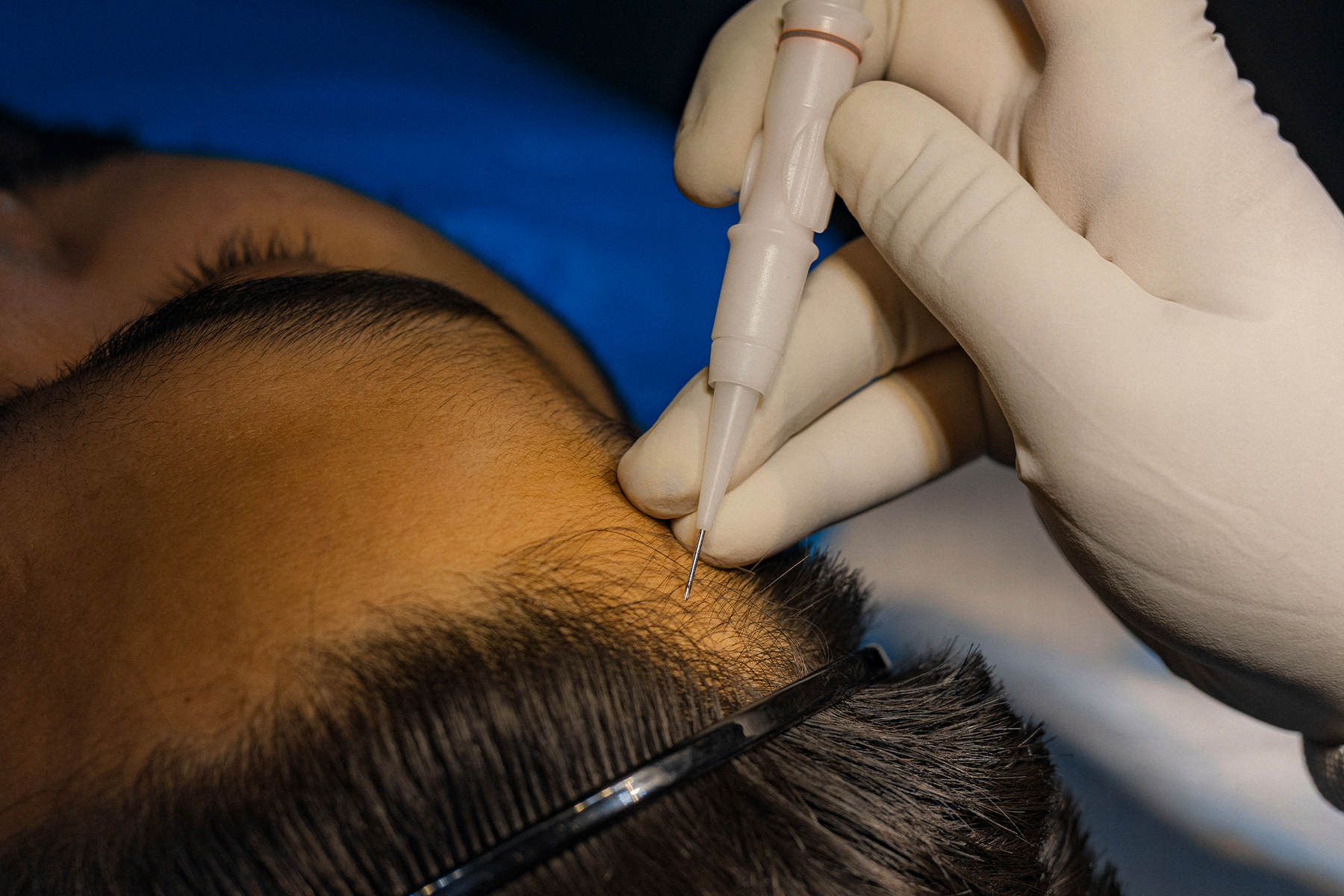
Direct hair transplant uses CHOI Implanter technology to place hair follicles without pre-made channels. This supports precise angulation, dense placement, and a no-shave option for selected patients. It is especially useful for hairline refinement and adding density between existing hairs.

What is direct hair transplant?
Direct hair transplant is an advanced evolution of FUE that uses CHOI Implanter technology. Extracted follicular units are loaded into the implanter and placed into the recipient area in a single step.
Because grafts spend less time outside the body, this method can support strong graft survival. The CHOI Implanter Pen also allows precise control over depth, direction, and angle, making it well suited for hairline work and density enhancement.
This approach is particularly useful for patients who want minimal shaving in the recipient area. At Zeeva Clinic, Dr. Anchal Shah uses premium sapphire-tipped CHOI implanters for precision placement.
How we perform Direct hair transplant at Zeeva
Every step is personally performed by Dr. Anchal Shah, with no technicians and no shortcuts.
Hairline design & density planning
Dr. Anchal Shah meticulously designs the hairline and maps density zones. Direct hair transplant allows precise placement between existing hairs, making it ideal for thickening.
Comfort-first anesthesia
Local anesthesia ensures a completely painless experience. A gentle needle-free technique is used for initial numbing.
Graft extraction
Individual follicular units are extracted from the donor area using a micro-punch tool. Every graft extracted by Dr. Anchal Shah personally.
Choi Pen Loading
Each graft is carefully loaded into a Choi Implanter Pen. Multiple pens are used in rotation for efficiency and minimal handling time.
CHOI implanter placement
Grafts are placed using the CHOI Implanter Pen without pre-made channels. Every graft is implanted by Dr. Anchal Shah personally, ensuring precise angle, depth, and density.
Key differentiator: Every graft extracted and implanted by Dr. Anchal Shah personally. No technicians handle the critical surgical steps.
Am I a candidate for direct hair transplant?
Ideal candidates
- ✓Patients seeking hairline refinement or temple restoration
- ✓Those wanting to add density to thinning areas without shaving
- ✓Women with diffuse thinning patterns
- ✓Patients requiring precision work in small to medium areas
- ✓Those who want maximum naturalness in the hairline zone
May not be ideal for
- ✗Very large bald areas requiring 5,000+ grafts in one session
- ✗Patients with very limited donor hair supply
- ✗Active scalp conditions requiring treatment first
Norwood scale note: Direct hair transplant is best suited for Norwood II-IV and for density boosting in areas that still have some existing hair.
Before and after results
Real patient results from Zeeva Clinic. All procedures performed by Dr. Anchal Shah.

 BeforeAfter
2,500 grafts
United Kingdom

 BeforeAfter
2,000 grafts
United States

 BeforeAfter
3,000 grafts
India
BeforeAfter1,800 grafts
Saudi Arabia

 BeforeAfter
2,200 grafts
Kenya
BeforeAfter2,800 grafts
Germany
FUE vs direct hair transplant technique comparison
Understand the differences to make an informed decision with Dr. Anchal Shah.
| Feature | FUE | Direct hair transplant |
|---|---|---|
| Extraction method | Individual follicles via micro-punch | Individual follicles via micro-punch |
| Implantation | Pre-made channels, then graft placement | CHOI implanter placement without pre-made channels |
| Scarring | Tiny dot scars (nearly invisible) | Tiny dot scars (nearly invisible) |
| Recovery time | 7-10 days | 7-10 days |
| Graft survival rate | 95-98% | 95-98% |
| Max grafts per session | 4,000-5,000 | 3,000-4,000 |
| Shaving required | Yes (donor area) | Partial / No-shave option |
| Best for | Large areas, versatile | Hairline refinement, density boost |
| Cost (INR) | From ₹75,000 | From ₹90,000 |
Recovery timeline
Procedure day
Mild swelling and numbness. Bandage applied. Rest at hotel or home. Pain medication provided.
Initial healing
Tiny scabs form around grafted area. Gentle washing begins on Day 3. Avoid strenuous activity. Sleep elevated.
Shedding phase
Transplanted hair sheds. This is completely normal and expected. Donor area fully healed. Resume normal activities.
Early growth
Fine, new hair begins to emerge from transplanted follicles. Growth may be uneven at first. This is perfectly normal.
Visible progress
Significant new hair growth visible. Hair thickens and gains texture. Results start to take shape.
Final results
Full results visible. Hair has natural density, direction, and texture. Final assessment with the Zeeva Clinic team.
Pricing
Starting at
₹90,000
Direct hair transplant pricing reflects the specialized CHOI Implanter technology. International patient packages are available with accommodation, transfers, and post-op care included.
Frequently asked questions
A crown hair transplant focuses specifically on restoring hair at the vertex, the circular area towards the back and top of the head where many men first notice thinning. This area often has a distinctive spiral or whorl pattern in the way hair naturally grows.
Treating the crown is considered technically demanding, partly because of this whorl pattern and partly because the crown can require a large number of grafts to achieve visible density, since hair naturally sits at a wider spacing in this region compared to the front.
Surgeons need to carefully recreate the natural spiral direction when placing grafts, rather than positioning them in a uniform pattern. Getting this wrong can create an obviously artificial appearance, even if the density itself looks good.
Because crown hair loss can also continue to expand outward over time, planning for future changes is important. A skilled surgeon will consider how your crown area might evolve in the years ahead, designing a result that will continue to look balanced and natural well into the future.
A beard transplant restores facial hair using the same basic principle as a scalp transplant, moving healthy hair follicles into areas of the beard that grow patchy, thin, or not at all. It is a popular option for men wanting a fuller, more even beard.
Hair for a beard transplant is usually taken from the scalp, most often the back or sides, since this hair closely matches the natural texture of facial hair once grown out. In some cases, hair from other parts of the body may be used for specific density needs.
During the procedure, each graft is placed individually, taking great care with the angle and direction, since facial hair grows in a very different pattern to scalp hair. Getting this right is essential for a beard that looks natural rather than obviously transplanted.
Recovery is generally quick, with initial redness settling within a few days. As with scalp transplants, the newly placed hairs shed temporarily before permanent growth begins, usually becoming fully visible within several months.
An eyebrow transplant restores thin, sparse, or missing eyebrows by transplanting individual hair follicles, usually taken from the scalp, into the eyebrow area. It suits people affected by over-plucking, ageing, scarring, certain medical conditions, or simply naturally sparse brows.
This procedure demands a very high level of precision, since eyebrows are small, highly visible, and framed by delicate surrounding skin. Each hair must be placed at a very specific, shallow angle to match the natural direction in which eyebrow hair grows, which differs noticeably from scalp hair direction.
Surgeons also pay close attention to shape and symmetry, working with your natural bone structure and existing brow shape rather than applying a generic template. A well-designed eyebrow transplant should suit your face rather than look like a fixed pattern copied from someone else.
Because scalp hair grows faster and longer than natural eyebrow hair, transplanted eyebrows generally need periodic trimming to maintain their shape once fully grown in, similar to how you might trim natural brow hair that grows a little too long.
A beard to head hair transplant uses hair from the beard as a donor source for the scalp, rather than the other way around. It is typically considered for patients who need more grafts than their scalp donor area alone can safely provide.
This situation often arises with advanced baldness, where the scalp's donor area has a limited supply of hair relative to the large bald area needing coverage. Beard hair, which tends to be thicker and more robust, can supplement this supply effectively.
In practice, surgeons usually reserve scalp donor hair for the hairline itself, since it is finer and creates a more natural-looking frame for the face. Coarser beard hair is then used to add density behind the hairline, filling in the mid-scalp and crown areas.
Blending these two hair types successfully requires real surgical skill, carefully matching angle and direction so the different hair textures grow together as one natural-looking result, rather than looking like two visibly different types of hair side by side.
Hair transplant repair, sometimes called corrective or revision surgery, is a specialised procedure designed to fix or improve the outcome of a previous hair transplant that did not go as planned. It is more complex than a first-time transplant and requires particular skill.
Common issues that lead patients to seek repair include an unnatural, overly straight hairline, old-style large "pluggy" grafts that look artificial, patchy or thin density from a poorly executed procedure, hair growing in the wrong direction, and visible scarring from outdated techniques.
The repair process usually starts with a detailed assessment of what went wrong and how much healthy donor hair remains available. From there, a surgeon might redesign the hairline using finer grafts, add extra density between existing grafts, or in some cases carefully remove and relocate old, poorly placed grafts.
Because repair work often involves correcting existing problems while adding new grafts, it generally takes longer and demands more surgical judgement than a standard procedure. Choosing a highly experienced surgeon is especially important for this type of work.
Yes, hair from other parts of the body, most commonly the beard, and sometimes the chest or back, can be used as an additional donor source. This is known as body hair transplantation and is generally considered when scalp donor hair alone is not enough.
This situation typically applies to patients with very advanced baldness, where the area needing coverage is large but the scalp's own donor supply is limited. Rather than turning patients away, surgeons can supplement scalp grafts with carefully selected body hair.
Body hair often has a different texture and growth cycle compared to scalp hair, so it is usually reserved for adding density in the mid-scalp or crown rather than for the hairline itself, where finer scalp hair gives a more natural framing effect.
Blending body hair successfully with scalp hair takes real expertise, since the surgeon must match growth angle and direction carefully to avoid an uneven or patchy appearance. This technique has opened up realistic options for patients who were previously told a transplant was not possible for them.
A hair transplant will last a lifetime, and for most patients, it does. This is because the hair used comes from the back and sides of the scalp, an area that stays resistant to pattern baldness (DHT Hormone) even as a person ages.
Once these follicles are moved to a new spot, they carry that same resistance with them. This means the transplanted hair keeps growing on its own, in the same way it would have kept growing if it had never been moved.
It helps to separate two things here. The grafts themselves are permanent. The overall look of your hair, however, also depends on what happens to the hair around those grafts, which was not part of the transplant.
If your hair loss is still active in untreated areas, that surrounding hair can keep thinning over the years, even though the transplanted grafts stay in place. This is why many surgeons suggest pairing a transplant with ongoing medical care for the rest of your hair, so the whole result continues to look balanced for decades, not just in the first year or two.
The grafts placed during your transplant will not go bald again, since they come from hair that is naturally resistant to the DHT hormone behind pattern baldness. That part of the result is considered permanent.
However, the areas that were not transplanted are a different story. If your genetic hair loss is still progressing, the natural hair surrounding your transplant can continue to thin over time, in exactly the same way it would have without any surgery.
This is one of the most misunderstood parts of hair transplant surgery. People sometimes assume the whole head is now protected, when in fact only the moved follicles carry that protection. Over many years, this can create a slightly uneven look if nothing is done to manage the surrounding hair.
The good news is that this is manageable. Many patients use ongoing treatments such as medication, PRP, or GFC therapy to slow down loss in the untreated areas. A good surgeon will discuss this honestly with you before your procedure, rather than letting you assume the whole head is now permanently fixed.
Yes, transplanted hair behaves just like the rest of your natural hair, including the process of greying over time. This is because it is still your own living hair, simply moved to a new location on your scalp.
Greying happens when pigment-producing cells within the hair follicle gradually slow down or stop working, usually as part of natural ageing. Since the transplanted follicle is a complete, living unit, moving it does not change how it will age in the future.
This means if the hair from your donor area was already showing some grey strands at the time of your transplant, those specific hairs may still be grey once relocated. Equally, dark hairs that were transplanted will eventually go grey at roughly the same rate they would have if they had never been moved.
Some patients ask whether this can be avoided by choosing only dark hairs during extraction. While surgeons can be selective to some extent, greying is largely determined by genetics and age rather than by the transplant procedure itself, so it cannot be fully prevented through graft selection alone.
When performed well, hair transplant results should be genuinely impossible to spot. Achieving this depends on far more than simply moving hair from one area to another, it comes down to careful planning and artistic judgement throughout the procedure.
The angle and direction of each graft matter enormously. Natural hair does not grow in perfectly straight, evenly spaced rows, it grows with subtle variation, often changing direction slightly across different areas of the scalp. A skilled surgeon recreates this natural irregularity rather than lining hairs up too neatly.
Hairline design is equally important. A good surgeon considers your age, face shape, and existing hair pattern before deciding where the new hairline should sit. A hairline placed too low, too straight, or too symmetrical can look obviously artificial, even if the actual hair growth is healthy.
Most surgeons recommend waiting until at least the mid-twenties, ideally once your hair loss pattern has become clear and stable rather than still actively progressive. This timing gives the best chance of a result that continues to look natural for decades.
Having a transplant too early carries a specific risk. If hair loss is still progressing, the existing hair surrounding a young patient's transplant can keep thinning afterwards, sometimes creating an unusual island of dense, transplanted hair surrounded by ongoing baldness.
There is no fixed upper age limit either. Many patients in their fifties and beyond have successful transplants, as long as they are in reasonably good general health and have enough donor hair available.
Rather than focusing purely on a specific number, the more useful question is whether your hair loss pattern has settled and whether you have realistic expectations for the result. A proper consultation, assessing your donor hair, hair loss stability, and overall health, gives a far more accurate answer than age alone ever could.
Whether a hair transplant is worth it depends largely on your personal goals, expectations, and how much hair loss is affecting your confidence day to day. For many people who feel genuinely bothered by thinning hair, a well-performed transplant offers a permanent, natural-looking solution that other options simply cannot match.
Compared to ongoing options like hairpieces or ongoing medication, a transplant involves a larger upfront decision and cost, but it avoids the continuous maintenance, replacement.
Value also depends heavily on choosing the right provider. A skilled, qualified surgeon delivering natural, long-lasting results represents strong value, even at a higher price. A poorly performed procedure, regardless of cost, can leave a patient needing corrective surgery later, which adds both expense and disappointment.
The best way to judge whether it is worth it for you personally is through an honest consultation, understanding your specific hair loss pattern, realistic expected results, and total cost, rather than comparing it in the abstract to other options without that personal context.
Yes, like any surgical procedure, there are some genuine downsides worth understanding before you decide.
Recovery time is one factor. While most patients return to normal activities within one to two weeks, some temporary swelling, scabbing, and mild discomfort are part of the process, along with a waiting period of many months before final results become visible.
Donor hair is also a limited resource. Once used, it cannot regenerate, meaning patients with very advanced hair loss may not have enough donor supply to fully cover every area they would like treated, which requires careful planning and sometimes compromise around priorities.
There is also the possibility of an unsatisfactory result if the wrong provider is chosen, ranging from an unnatural hairline to poor graft survival. This particular downside, however, is largely avoidable through careful research and choosing a genuinely qualified, experienced surgeon rather than the cheapest option available.
There is no single perfect age that suits everyone, since hair loss patterns and life circumstances vary a great deal from person to person. That said, most surgeons generally recommend waiting until the mid-twenties at the earliest, once hair loss has become more predictable.
The reasoning behind this is practical rather than arbitrary. Hair loss in the late teens and early twenties is often still evolving, making it harder to plan a hairline and graft distribution that will still look balanced many years down the line.
For patients in their late thirties, forties, and beyond, hair loss patterns have usually settled considerably, which often makes planning more straightforward. Age alone does not disqualify anyone from having a transplant, as long as general health is good and enough donor hair remains available.
Ultimately, the right age for you personally comes down to how stable your hair loss pattern is, rather than a fixed number. A detailed consultation, examining your donor density and hair loss history, gives a far more useful answer than any general age guideline alone.
Ten years on, the transplanted grafts themselves should still be present and growing, since they carry the same lifelong resistance to pattern baldness that they had in their original donor location. This part of your result is designed to remain stable for life.
What can change over a decade is the surrounding, untreated hair, particularly if your genetic hair loss was still active at the time of surgery. Without ongoing treatment, this natural hair can continue thinning gradually, which may create a slightly different balance between transplanted and natural areas compared to the first year or two.
General ageing also plays a role over this timeframe. Hair texture, thickness, and colour naturally shift somewhat as people get older, and transplanted hair follows these same changes, since it behaves exactly like the rest of your natural hair.
Patients who combine their transplant with ongoing supportive treatment for their remaining hair, such as medication or periodic clinic therapies, tend to maintain a more consistent, balanced appearance across this longer timeframe. Regular check-ins with your clinic can help track these gradual changes and adjust any supportive care as needed.
A hair transplant is not suitable for everyone, and a responsible clinic will identify this during a proper consultation rather than proceeding regardless. People with certain uncontrolled medical conditions, such as unmanaged diabetes or significant blood clotting disorders, are generally advised to control medical issues before planning hair transplant.
Patients with insufficient donor hair are another important group. This includes people with very advanced, widespread hair loss where the donor area cannot realistically supply enough grafts to make a meaningful visible difference, or those with certain types of diffuse thinning where the donor area itself is affected.
Very young patients, typically under 22, are usually advised to wait, since their hair loss pattern may still be actively progressive. Operating too early risks an unnatural result later, as untreated surrounding hair continues to thin.
People with unrealistic expectations, expecting results that no surgical technique can genuinely deliver, are also generally advised to pause and have a more detailed discussion first. A thorough, honest consultation is the best way to determine whether you personally fall into any of these categories.
This depends heavily on grade of baldness, donor area availability and your expectation. If top, front, and crown of your scalp are bald but you still have healthy, dense hair at the back and sides, a hair transplant is generally still very possible, since this donor area is what supplies the grafts.
However, if someone has lost hair everywhere, including the back and sides of the scalp, such as in diffuse forms of hair loss, traditional donor supply becomes very limited or unavailable. In these specific cases, a standard scalp-to-scalp transplant may not be realistic.
In some situations, body hair from areas such as the beard can be used to supplement a very limited scalp donor supply, though this depends heavily on individual hair characteristics and cannot always fully replace a completely absent donor area.
For patients with extremely limited donor hair overall, non-surgical alternatives such as scalp micropigmentation or hair patches may offer a more realistic path to the appearance they want. A detailed, honest assessment of your specific donor area is essential to understand exactly which options are genuinely available to you.
Ready to get started?
Book an assessment with the Zeeva Clinic team. Get a personalised treatment plan, honest assessment, and transparent pricing with clear next steps.
- Video assessment with the Zeeva Clinic team
- Personalised treatment plan and cost estimate
- Before/after photos of similar cases shared
- All-inclusive packages for international patients
Book your assessment
Get a personalised hair restoration plan