Facial hair restoration
Beard transplant
Achieve the full, well-defined beard you have always wanted. Using precision FUE techniques, Dr. Anchal Shah transplants hair follicles from the scalp to your face, creating a natural, permanent beard tailored to your facial structure.
What is a beard transplant?
A beard transplant is a hair restoration procedure that uses Follicular Unit Extraction (FUE) to harvest individual hair follicles from the scalp donor area and transplant them to the beard, moustache, sideburn, or goatee region.
This procedure is ideal for men with patchy beards, thin facial hair, scarring from injuries or surgery, or those who genetically cannot grow a full beard. The transplanted hair is permanent and grows naturally, requiring regular grooming just like natural beard hair.
Dr. Anchal Shah pays meticulous attention to the angle, direction, and density of each implanted graft to ensure the beard looks completely natural, matching the growth patterns of existing facial hair.
How we perform Beard transplant at Zeeva
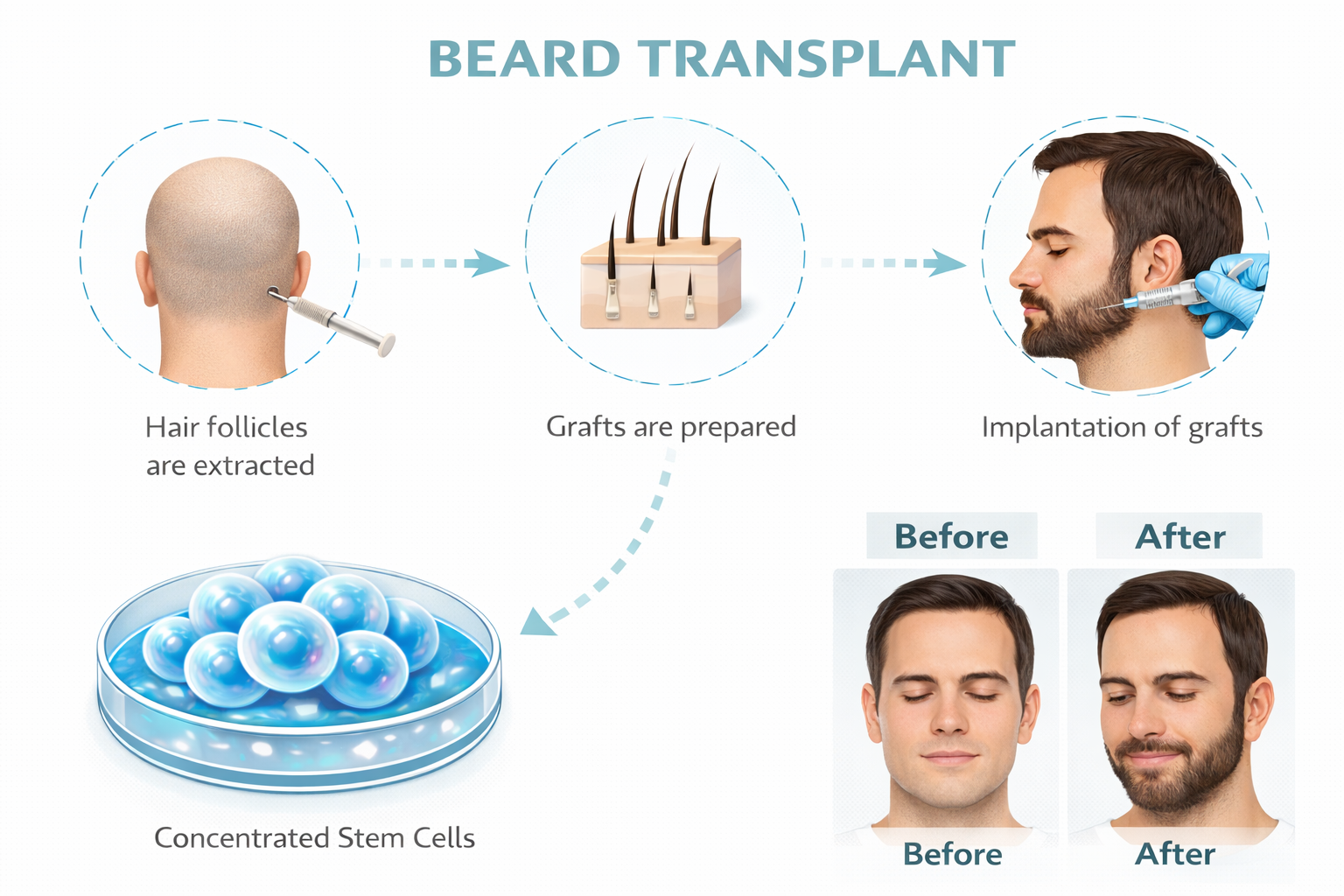
Every step is personally performed by Dr. Anchal Shah, with no technicians and no shortcuts.
Beard design consultation
Dr. Anchal Shah designs your desired beard shape, density, and style, whether full beard, goatee, sideburns, or moustache. The design complements your facial structure.
Local anesthesia
Both donor (scalp) and recipient (face) areas are numbed. The procedure is comfortable and painless.
Graft extraction
Fine, single-hair follicular units are extracted from the scalp using micro-punch FUE. Every graft extracted by Dr. Anchal Shah personally.
Channel creation
Tiny channels are created in the facial skin at precise angles matching natural beard growth direction, which is critical for a natural result.
Graft implantation
Each graft is placed individually to create natural density and growth patterns. Every graft implanted by Dr. Anchal Shah personally.
Key differentiator: Every graft extracted and implanted by Dr. Anchal Shah personally. No technicians handle the critical surgical steps.
Am I a candidate for beard transplant?
Ideal candidates
- ✓Men with patchy or thin beard growth
- ✓Those unable to grow a full beard genetically
- ✓Scar camouflage on the face (acne, burns, surgery)
- ✓Transgender patients seeking masculine facial hair
- ✓Men wanting to reshape or enhance their existing beard
May not be ideal for
- ✗Active acne or skin infections in the beard area
- ✗Unrealistic density expectations (a beard transplant adds density, not instant thickness)
- ✗Insufficient scalp donor hair
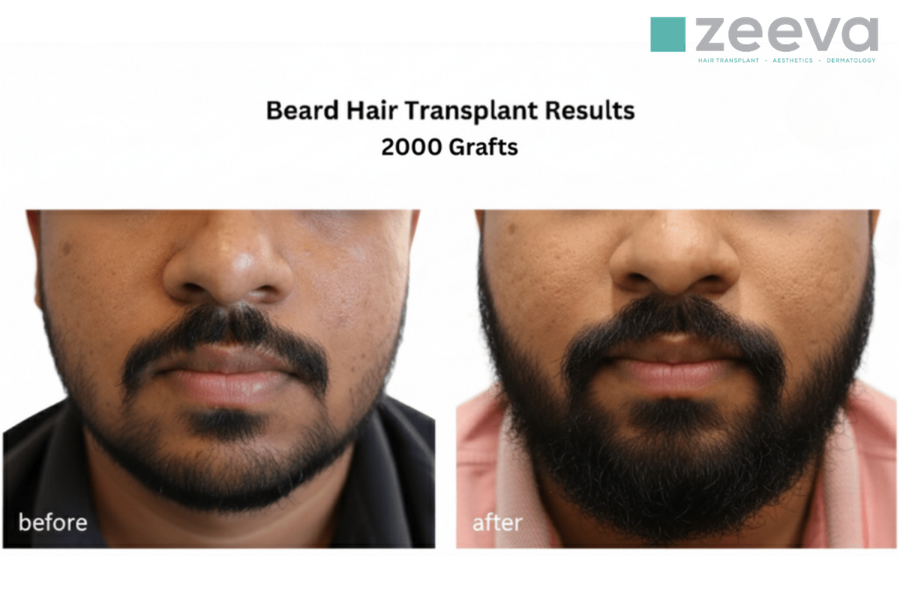
Before and after results
Real patient results from Zeeva Clinic. All procedures performed by Dr. Anchal Shah.

 BeforeAfter
2,000 grafts
UAE

 BeforeAfter
1,500 grafts
India

 BeforeAfter
2,500 grafts
Saudi Arabia
BeforeAfter1,800 grafts
United States
BeforeAfter1,200 grafts
United Kingdom
BeforeAfter2,200 grafts
Kenya
FUE vs direct hair transplant technique comparison
Understand the differences to make an informed decision with Dr. Anchal Shah.
| Feature | FUE | Direct hair transplant |
|---|---|---|
| Extraction method | Individual follicles via micro-punch | Individual follicles via micro-punch |
| Implantation | Pre-made channels, then graft placement | CHOI implanter placement without pre-made channels |
| Scarring | Tiny dot scars (nearly invisible) | Tiny dot scars (nearly invisible) |
| Recovery time | 7-10 days | 7-10 days |
| Graft survival rate | 95-98% | 95-98% |
| Max grafts per session | 4,000-5,000 | 3,000-4,000 |
| Shaving required | Yes (donor area) | Partial / No-shave option |
| Best for | Large areas, versatile | Hairline refinement, density boost |
| Cost (INR) | From ₹75,000 | From ₹90,000 |
Recovery timeline
Procedure day
Mild redness and swelling on the face. Small scabs around each graft. Avoid touching or rubbing the area.
Initial healing
Scabs naturally fall off. Redness fades. Gentle face washing allowed. Avoid shaving the transplanted area.
Shedding phase
Transplanted hairs shed. This is completely normal. Skin returns to normal appearance. You can shave carefully.
Early growth
New beard hair begins to emerge. Initially fine, it will thicken over the coming months.
Visible beard
Significant new growth. Beard begins to fill in and take final shape. Can style and groom normally.
Final results
Full, natural beard growth established. Hair is permanent and can be groomed, trimmed, and styled like natural beard hair.
Pricing
Starting at
₹50,000
Beard transplant cost varies based on the area covered and number of grafts (typically 1,000-3,000). International patient packages available.
Frequently asked questions
The scalp is the safest and most reliable donor source for most men. It holds thousands of healthy follicles, and the hair at the back and sides of the head keeps growing for life. That makes it a strong source for a beard that is meant to be permanent.
The surgeon looks for the finest hairs to match facial hair. Fine, single hair grafts are preferred, because they look natural on the cheeks and neck. Thicker grafts can look too heavy on the face. Taking them from a suitable zone of the scalp gives the surgeon good control.
The donor area on the scalp is chosen with care. Hair is taken from across a wide area, so that no one spot is thinned out. The tiny marks heal quickly and are hidden by the hair around them. Most men do not notice any change in their scalp once it heals.
Once moved to the face, the hair keeps some of its scalp character. It may grow a little faster and longer than your own beard hair, and may need more trimming. Over time, many patients find it blends in well. Dr. Anchal Shah will explain what to expect for your hair type.
A beard transplant suits men with patchy, thin or uneven facial hair. It also helps men who cannot grow a beard at all, or who have gaps around the cheeks, chin or jawline. If you are tired of shaving off the patches or hiding them, this may help.
It is also useful for covering scars. Marks from acne, burns, injuries or past surgery can be camouflaged by placing grafts into the scarred skin. Results in scar tissue can vary, so the surgeon will examine the area before advising you.
You need enough healthy hair on your scalp to act as the donor. The skin of your face should also be free from active infection or acne in the area to be treated. If you have a skin problem, it is better to treat it first and have the procedure afterwards.
Realistic expectations matter. A beard transplant adds density over time, but it does not give a thick beard overnight. It also takes about a year to see the final result. Dr. Anchal Shah will talk through your goals and show you what is possible for your face before you decide. Bring any questions to your assessment, because a clear talk at the start helps you decide with real confidence.
Yes, in many cases it can. Hair grafts can be placed into scarred skin to help cover marks from acne, burns, cuts, accidents or past operations. When the hair grows, it breaks up the look of the scar and helps it blend into the beard.
Scar tissue has less blood supply than normal skin. This means grafts may take less well in scarred areas, so the surgeon may place them more carefully or use more of them. Some scars respond very well, while others give a partial result. An honest assessment is important.
The type of scar matters. Flat, healed scars usually work better than raised or very tight scars. Recent scars need time to settle first, often a year or more. Your surgeon may ask you to wait until the scar is mature before planning the transplant.
You can send clear photos of the scar to the clinic for a first opinion. The team will tell you whether grafting is likely to help, and how many grafts it might need. In some cases, other treatments for the scar may be used first. Dr. Anchal Shah will guide you on the best order. Ask the team to explain what a partial result would look like for your scar, so you know what to expect.
Yes. A beard transplant does not have to cover the whole face. You can choose a single area, such as a moustache, a goatee, a chin patch or sideburns. The procedure is planned around the look you want.
Smaller areas need fewer grafts. A moustache or goatee may need around 500 to 1,000 grafts, while a full beard usually needs 2,000 to 3,000. Patchy areas may need as few as 500 to 800. Fewer grafts often means a shorter day and a lower cost.
The design is the most important step. Dr. Anchal Shah draws the shape on your face and checks it with you before any numbing. You can look in the mirror and agree on the edges, the thickness and the style. Both sides are made to match as closely as possible.
Many men start with a smaller area and add more later. This is possible, as long as you have enough donor hair on your scalp. If you want to blend the new hair with your existing beard, tell the surgeon. The grafts will be placed to match the angle and direction of the hair already there. Take your time to look at examples of finished moustaches and goatees, so you can choose a style that suits your face.
The tiny dots where grafts were taken usually heal within days. They look like pinpricks and are hidden by the hair around them. There is no long scar, because the method used is FUE and not strip surgery.
In the first week, you may see small red dots and scabs at the back of the head. These fade quickly. Most men find that by the second or third week, the donor area looks normal again. The scalp hair grows back over the trimmed area within a few weeks.
The donor area is usually trimmed short before surgery so the surgeon can see each hair clearly. For a beard transplant, only a small amount is needed, so the trimmed patch is often small. Many men can cover it with the longer hair above it, though this depends on how much is taken.
Taking too much from one spot can leave a thin look. That is why the surgeon spreads the extraction over a wide zone. If you like to wear a very short haircut, mention this early. It helps the surgeon plan the harvest so the back of your head looks even. If you notice any redness that lasts, or a patch that looks thin, mention it at your follow up so the team can check it.
It takes patience. The transplanted hairs shed in the first month. This is normal and does not mean the procedure has failed. The follicles stay alive under the skin and start to grow again later.
New hair appears from around month three. It is thin and soft at first, and it may look uneven. By month six, the beard begins to fill in and take shape. Most men can style and groom it normally by this point, though it is still developing.
The full result is usually seen at around twelve months. By then the hair has thickened and settled into its final pattern. Some patients see a little more change up to eighteen months. The time varies from person to person, and your surgeon will track your progress.
During this time, avoid judging the result too early. A common worry at month two or three is that nothing has changed. Taking photos in the same light each month can help you see slow progress. If you have concerns, contact the clinic. Follow-up photos give the team a chance to check your healing and guide you. Remember that every face is different, and your own timeline may be a little faster or slower than the average described here.
Keep the area clean and leave it alone. Small scabs form around each graft, and they need time to fall off by themselves. Do not scratch, pick or rub them, even if they itch. Touching the area too soon can move a graft.
Wash gently as the team shows you. Usually this means using a mild cleanser and patting the skin dry with a soft towel. Avoid hot water, steam and strong soaps. Keep your hands clean before touching your face, and avoid kissing or heavy contact for the first few days.
Do not shave the transplanted area in the first week. The clinic will tell you when it is safe to start trimming. Avoid direct sun, heavy sweat, swimming and gym workouts for the first couple of weeks. Wearing a clean, loose mask or scarf is better avoided on the grafted skin unless advised.
Sleep with your head slightly raised for the first few nights, and avoid lying with your face pressed into the pillow. Take any medicines as directed. If you see spreading redness, pus, strong pain or a fever, contact the clinic straight away. Most patients heal without any problem. Following the plan closely in this first week gives your new hairs the best chance to settle and grow well.
There is no fixed legal age in the way people sometimes think, but most surgeons advise waiting until the early to mid twenties. Facial hair keeps developing for many years after puberty. A beard that looks thin at nineteen may fill in a lot by twenty five.
If you have the transplant too early, you may find that your own beard grows in later. This can leave you with a mix of natural and transplanted hair that looks uneven. Waiting lets the surgeon see what your natural beard will do before adding anything.
The surgeon will look at your age, family pattern and the way your beard has grown so far. If your father and other male relatives have full beards, yours may still come in. If they all have thin or patchy beards, the pattern may be genetic and unlikely to change.
For adults with scars or a clear lack of facial hair, the choice can be made sooner. A proper assessment is key. Dr. Anchal Shah will tell you honestly if it is better to wait. You can send photos online for a first view, and visit the clinic for a full check. Waiting a little longer is often a small price to pay for a beard that looks balanced for life.
At Zeeva Clinic, a beard transplant starts from around ₹50,000. The final price depends on how many grafts you need and the area you want to cover. Most beard transplants use between 1,000 and 3,000 grafts.
A moustache or goatee needs fewer grafts, so it costs less than a full beard. A full beard with sideburns and cheeks needs more. The surgeon will count the grafts after reviewing your face and your goals, and you will get a clear quote after your assessment.
International patients can ask about all-inclusive packages. These cover the procedure, hotel stay, airport transfers and aftercare. This makes it easier to plan your trip and your budget. Ask the team for a list of what is included, so you can compare it fairly with other clinics.
Cost is only part of the picture. A beard transplant needs a good eye for direction and density. A poor result is hard to fix on the face, where every hair is visible. Choose a surgeon who personally performs the procedure, and ask to see before and after photos of beard cases at twelve months. Ask the team to explain every line of the quote in plain words, so there are no questions left once you arrive in Ahmedabad.
Yes, in many cases. If you have little or no facial hair, a transplant can create a beard using hair from your scalp. The grafts are placed one by one in the pattern you choose, so you get hair where none was growing before.
The result depends on the quality of your donor hair. You need enough healthy hair on your scalp to supply the grafts. Fine, single hair grafts are used for the cheeks and neck. The surgeon plans how to cover the areas you care about the most.
A full beard from nothing needs a good number of grafts, often in the 2,000 to 3,000 range. The density you can reach has a limit, since a transplant adds hair but cannot fully copy the thickness of a naturally full beard. A clear talk about what is realistic helps you decide.
Some medical conditions can stop facial hair from growing. If you have a hormone problem or a health issue, it may be worth checking with your doctor first. The surgeon will ask about this during your assessment. Once the plan is clear, the transplanted beard is permanent and can be groomed like any other. Ask to see results from similar cases, so you can judge what is realistic before you make your decision.
Ready to get started?
Book an assessment with the Zeeva Clinic team. Get a personalised treatment plan, honest assessment, and transparent pricing with clear next steps.
- Video assessment with the Zeeva Clinic team
- Personalised treatment plan and cost estimate
- Before/after photos of similar cases shared
- All-inclusive packages for international patients
Book your assessment
Get a personalised hair restoration plan