PRP hair therapy
Platelet-Rich Plasma (PRP) therapy harnesses your body's own growth factors to stimulate dormant hair follicles, strengthen existing hair, and enhance transplant results. A safe, non-surgical treatment backed by extensive clinical research.
What is PRP therapy for Hair?
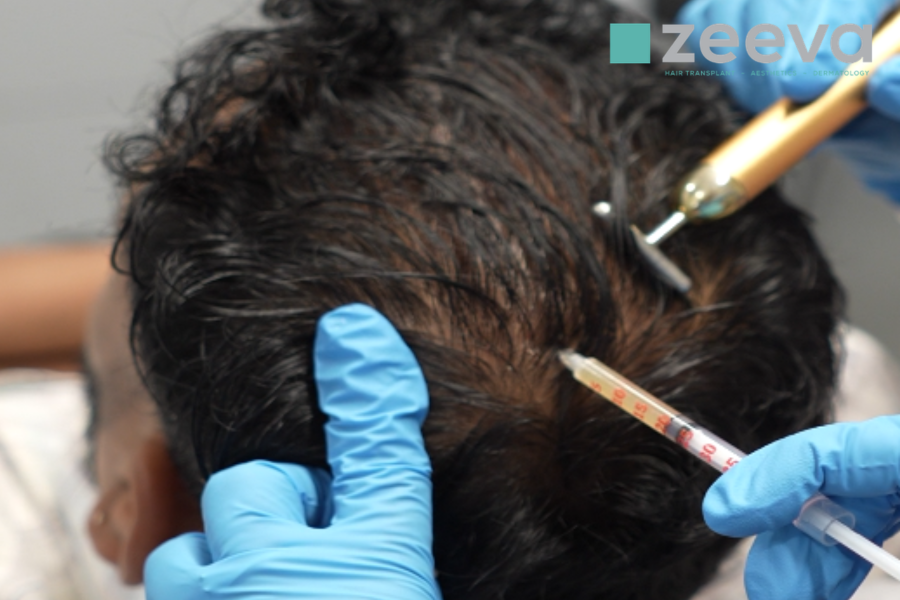
PRP (Platelet-Rich Plasma) therapy involves drawing a small sample of your blood, processing it in a centrifuge to concentrate the platelets and growth factors, and then injecting this concentrated plasma directly into the scalp.
Platelets contain powerful growth factors (PDGF, TGF, VEGF, EGF) that stimulate hair follicle stem cells, promote new blood vessel formation, and extend the active growth phase (anagen) of hair. This results in thicker, stronger hair and can reactivate dormant follicles.
At Zeeva Clinic, Dr. Anchal Shah uses an advanced double-spin centrifuge technique to achieve optimal platelet concentration, 5-7x baseline levels, for maximum therapeutic effect.
How PRP therapy Works
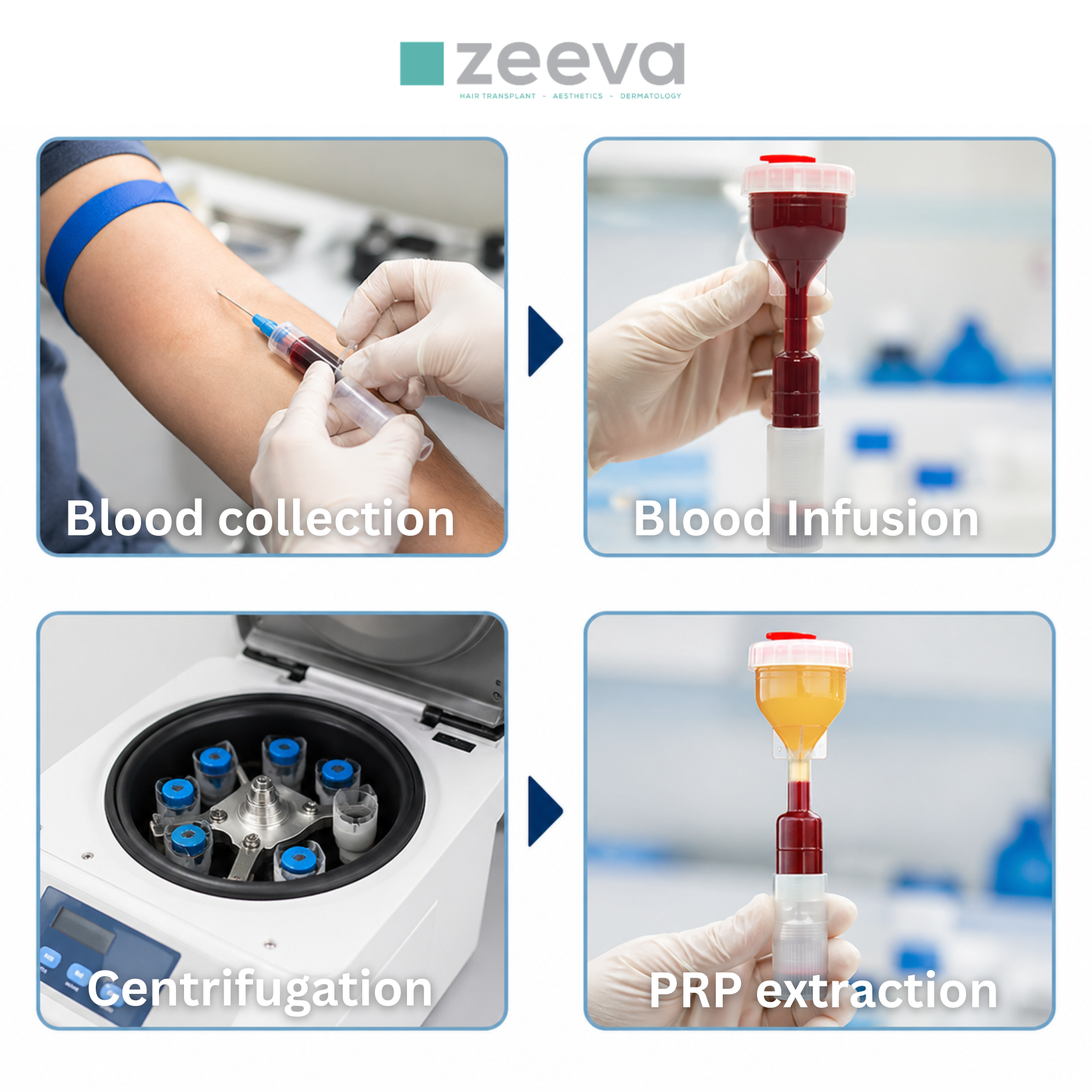
Blood draw
A small sample (20-30ml) of your blood is drawn, similar to a routine blood test.
Centrifuge processing
The blood is processed in an advanced centrifuge to separate and concentrate the platelet-rich plasma layer.
Activation
The concentrated PRP is activated to release maximum growth factors.
Micro-injection
PRP is injected into the scalp at the level of the hair follicles using fine needles. The procedure takes 30-45 minutes.
Benefits of PRP therapy
Who is PRP therapy For?
- ✓Early-stage male or female pattern hair loss
- ✓Thinning hair that has not progressed to baldness
- ✓Post-transplant patients (enhances graft survival and growth)
- ✓Patients wanting to delay or complement surgical treatment
- ✓Alopecia areata patients
- ✓Anyone wanting to strengthen and thicken their existing hair
Starting at
₹8,000 per session
Package pricing available for multiple sessions. Combination protocols with GFC or transplant available at discounted rates.
Book assessmentFrequently asked questions
PRP stands for Platelet-Rich Plasma. It is a non-surgical treatment that uses a concentrated part of your own blood to help stimulate weak or thinning hair follicles. It is often used for early-stage hair loss or alongside a hair transplant.
The process starts with a small blood sample, taken just like a routine blood test. This sample is then spun in a machine to separate out the platelet-rich portion, which contains natural growth factors that support tissue repair and cell growth.
This concentrated plasma is then injected into areas of the scalp showing thinning, where these growth factors are thought to encourage blood supply and support the health of existing follicles. A typical course involves several sessions spaced a few weeks apart, followed by occasional maintenance sessions.
PRP works best on follicles that are still active but weakened, rather than on scalp areas that have been completely bald for a long time. It is a supportive treatment rather than a replacement for a transplant in cases of advanced hair loss.
GFC stands for Growth Factor Concentrate. It is a treatment closely related to PRP, but with a more refined process designed to extract an even higher concentration of the specific growth factors involved in hair follicle health.
Like PRP, GFC starts with a blood sample from the patient. Using a specialised kit, this sample is processed to separate out a rich concentration of growth factors and proteins, while removing other blood components that are not needed for the treatment.
This concentrated solution is then injected into the scalp, targeting areas with visible thinning. The aim is to support the natural hair growth cycle, encouraging follicles to stay in their active growing phase for longer and improving overall hair thickness over time.
GFC is often chosen by patients looking for a slightly more concentrated alternative to standard PRP, and it is commonly used both as a standalone treatment for early hair loss and as a supportive therapy following a hair transplant, to support healthy healing and growth.
Exosome therapy is a newer, non-surgical treatment aimed at supporting hair growth using tiny cell-signalling particles called exosomes. These naturally occurring particles carry proteins and genetic material that help cells communicate with one another and support tissue repair.
In a hair treatment context, exosomes are applied to the scalp, often alongside a technique such as microneedling, which creates tiny channels to help the solution reach the deeper layers of skin where hair follicles are located.
The idea behind this therapy is that these signalling particles can help "wake up" follicles that are weakened but not completely inactive, encouraging them to re-enter a healthier growth phase. Research into exosome therapy for hair is still developing, though early results have been encouraging for many patients.
This treatment is generally used for people with early to moderate thinning, rather than completely bald areas with no active follicles. It can also be used as a supportive treatment after a hair transplant, to help support the healing process in the weeks following surgery.
Scalp micropigmentation, often shortened to SMP, is a non-surgical cosmetic treatment that uses fine pigment deposits to recreate the appearance of tiny hair follicles on the scalp. From a short distance, it creates the visual effect of closely shaved, short hair.
Unlike a tattoo using regular ink, SMP uses specialised pigments and a very fine needle technique to match the natural colour and texture of hair follicles, applied in tiny dots rather than solid lines. This gives a realistic, textured appearance rather than a flat, painted look.
SMP is commonly used to create the appearance of density for men who prefer to keep their hair very short, to camouflage scarring from a previous hair transplant, particularly the linear scars left by older strip surgery methods, or as a standalone solution for people who choose not to have a surgical transplant at all.
It does not involve any actual hair growth, so it works purely as a visual technique. Results typically last several years before a touch-up session is needed, as pigments can fade gradually over time, especially with regular sun exposure.
Low level laser therapy, often called LLLT, is a non-invasive treatment that uses red or near-infrared light to stimulate hair follicles. It is available in different forms, including in-clinic devices, handheld combs, and wearable caps that patients can use at home.
The light energy is thought to work at a cellular level, helping to improve blood flow to hair follicles and support the energy production process within cells. This is believed to help extend the active growth phase of hair and slow down the shedding phase.
LLLT tends to work best for early-stage hair thinning, where follicles are still present but weakened, rather than for areas of complete, long-term baldness. Consistency is important, since most devices need to be used regularly, often several times a week over several months, to see a noticeable improvement.
Many patients use LLLT as a supportive treatment alongside other approaches, such as medication or PRP, rather than as a standalone solution. It is generally considered a gentle, low-risk option with minimal side effects reported.
Stem cell hair therapy is an advanced, non-surgical treatment that aims to encourage hair regrowth by supporting dormant or weakened hair follicles using regenerative cell-based techniques. It represents one of the newer areas of research in hair restoration.
The general idea is that certain cells and growth signals can help reactivate follicles that have stopped producing visible hair but have not been completely lost. By supporting the surrounding tissue environment, the treatment aims to give these follicles a better chance of resuming healthy growth.
This is typically delivered through targeted scalp injections, sometimes combined with other supportive treatments such as PRP or microneedling, to enhance overall absorption and effectiveness. Multiple sessions are usually needed to see meaningful change.
As with several regenerative treatments, stem cell hair therapy is generally more suitable for early to moderate hair thinning rather than long-term, completely bald areas. It is often positioned as a complementary option alongside surgical hair transplant for patients seeking to protect and strengthen their remaining natural hair.
Interested in PRP therapy?
Book an assessment with the Zeeva Clinic team to find out if prp therapy is the right treatment for your hair restoration goals.
Chat on WhatsAppBook your assessment
Get a personalised hair restoration plan